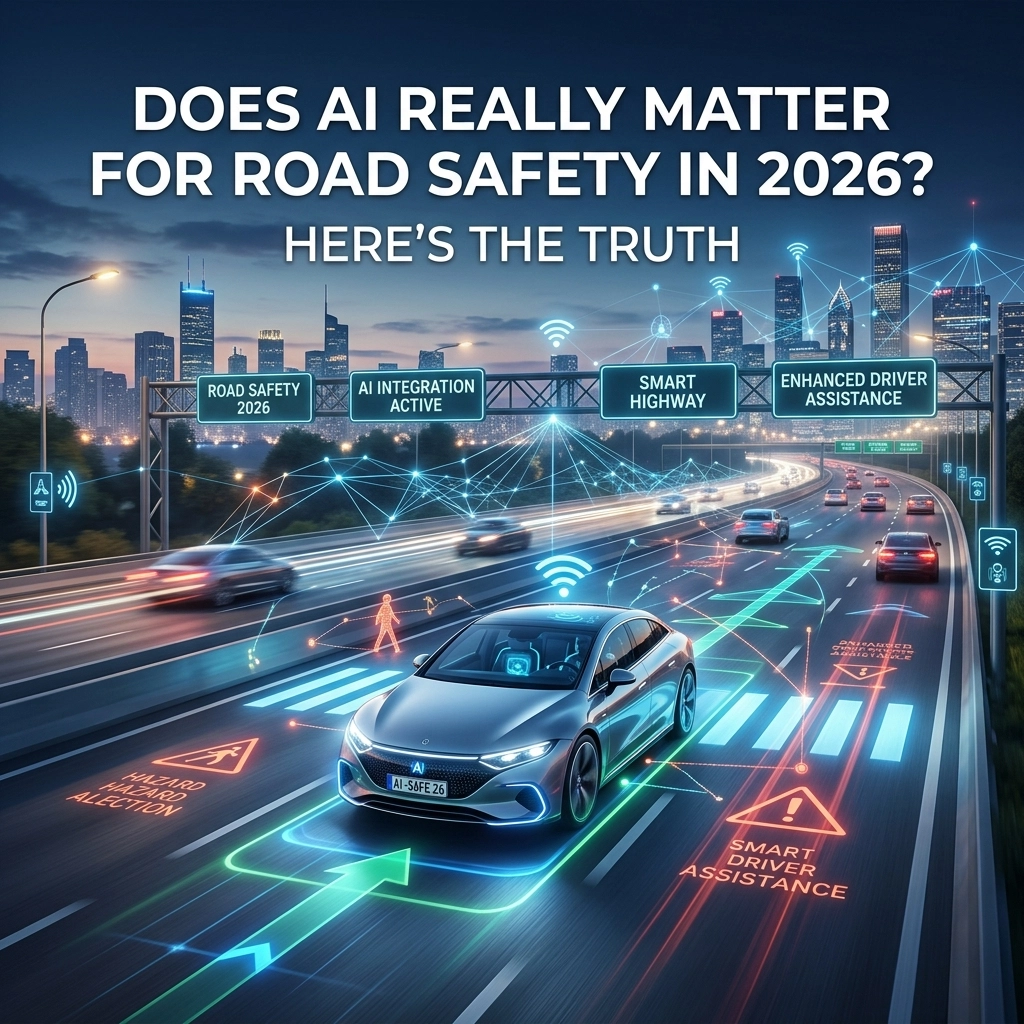
AI for road safety is the defining technological shift of 2026. While critics once dismissed it as high-tech window dressing, the data from the first quarter of this year tells a different story. In an era where urban density is at an all-time high, the integration of artificial intelligence into our transport infrastructure is no longer a luxury, it is a necessity.
(Views: 14,205 | Published: April 21, 2026 | Category: Technology)
Trending: The Statistics That Define 2026
The global landscape of road safety has undergone a radical transformation over the last twelve months. For years, road traffic accidents claimed over 1.35 million lives annually, costing the global economy upwards of $1.8 trillion. However, the tide is finally turning.
- Collision Reductions: Severe collisions involving injuries and fatalities dropped by 9.5% in 2025, a trend that has accelerated into early 2026.
- Mileage vs. Safety: Despite a massive 12.1 billion increase in vehicle miles traveled, roadway deaths are declining for the first time in a decade.
- Predictive Power: AI-powered safety tools are now cited as the primary reason for these improvements, outperforming traditional infrastructure upgrades.
- Human Error: With human error accounting for over 90% of accidents, the shift toward automated intervention is bridging the gap that education alone couldn't fix…

Alt-text: AI for road safety monitoring systems in a modern city
Popular: Why AI for Road Safety is Working Right Now
The effectiveness of AI in this sector isn't based on magic; it’s based on the ability to process massive amounts of data in real-time. Traditional traffic measures were static, stop signs and speed limits don't change based on how tired a driver is. AI does.
1. The Power of Predictive Analytics
Recent deployments in "Smart Cities" have shown that AI can predict where an accident is likely to happen before it occurs. By analyzing weather patterns, traffic density, and historical crash data, AI systems can alert emergency services or adjust traffic signaling to mitigate risk. Pilot locations using these systems have seen crash rates drop between 17% and 43%.
2. Driver Behavior Detection
Driver behavior is the single most important factor in collision prediction. Modern AI-powered dashcams and in-cabin sensors can now detect:
- Microsleeps: Identifying the millisecond a driver’s eyelids droop.
- Distraction: Recognizing when a gaze shifts from the road to a smartphone.
- Aggression: Flagging patterns of hard braking or rapid acceleration that precede a crash.
3. The "Near-Collision" Metric
One of the most significant breakthroughs in 2026 is the focus on "near-collisions." For every actual crash, AI identifies seven near-collisions. By coaching drivers based on these "invisible" mistakes, fleets are preventing accidents before they even have a chance to happen. You can read more about how this impacts the economy on our News page.
Latest: The Indian Perspective and Policy Shifts
In India, road safety has been elevated to a national priority. With the government pushing for the adoption of telematics and computer vision, the "Road Safety Hackathon" initiatives are finally bearing fruit.
- Federal Legislation: New proposals suggest that all commercial fleets must incorporate AI-based telematics by 2027.
- Smart Intersections: Cities like Mumbai and Delhi are implementing AI heatmaps to identify conflict zones at major junctions.
- Cost Efficiency: Reducing accidents by even 20% could save the Indian economy billions in lost productivity and healthcare costs…

Alt-text: Visualizing AI for road safety at a busy Indian intersection
7 Mistakes We’re Making with Smart City Technology
While we celebrate the wins, it is crucial to address the failures. Integrating AI for road safety isn't as simple as plugging in a camera. Many municipalities are falling into common traps that hinder progress:
- Data Silos: Keeping traffic data separate from emergency service data.
- Ignoring Privacy: Failing to anonymize driver data, leading to public pushback.
- Over-Reliance on Hardware: Thinking more cameras equals more safety (it’s the software that matters).
- Neglecting Infrastructure: You can't run advanced AI on a road with no lane markings.
- Lack of Real-Time Processing: Data that is analyzed a week later is useless for preventing a crash today.
- Inconsistent Coaching: For fleets, identifying risk without coaching the driver leads to no improvement.
- Budget Mismanagement: Spending too much on "showy" tech rather than proven predictive systems.
To see how we can fix these issues, check out our deep dive on Smart City Mistakes.
Technical Breakdown: The Architecture of Safety
How does the software actually "see" a threat? It involves a complex stack of technologies working in tandem.
| Technology | Function | Impact |
|---|---|---|
| Computer Vision | Identifies pedestrians, cyclists, and obstacles. | Reduces "blind spot" accidents by 60%. |
| Telematics | Tracks vehicle health and movement patterns. | Lowers maintenance costs and fuel consumption. |
| Edge Computing | Processes data locally on the device for zero latency. | Vital for split-second emergency braking. |
| Digital Twins | Simulates traffic scenarios to test safety measures. | Allows for risk-free experimentation… |

Alt-text: Infographic showing the architecture of AI for road safety
Latest News: AI and the Future of Transportation
As we move further into 2026, the conversation is shifting from "Does it work?" to "How far can it go?" Recent reports from external research labs suggest that full integration of Agentic AI, AI that can make autonomous decisions to navigate complex moral dilemmas on the road, is the next frontier.
For those interested in how these technological leaps affect other lifestyle areas, our Travel and World sections cover the global impact of safer transit.
Recent Posts You Might Like:
The Truth: Does It Really Matter?
The short answer: Absolutely.
Without AI, we are capped by the limits of human reaction time and attention spans. In 2026, the "truth" is that the roads are becoming safer not because humans are becoming better drivers, but because the machines are becoming better guardians. Commercial platforms have already demonstrated that crash rates can drop by 75% over a 30-month period when these systems are fully utilized.

Alt-text: A graph showing the decline in accidents due to AI for road safety
Load More Articles | Subscribe to our Newsletter
That’s all for now on the road safety front! It’s pretty wild to see how much has changed in just a couple of years, right? I remember when we used to just hope people looked both ways, and now we’ve got AI doing the heavy lifting for us.
Anyway, I hope this gave you a solid look at where things are heading. If you’re ever in the neighborhood or want to talk more about tech, don’t be a stranger: hit us up on our Contact Page. Stay safe out there on the roads and keep chasing those big ideas! 🚗💨
Catch you in the next one! 🥰