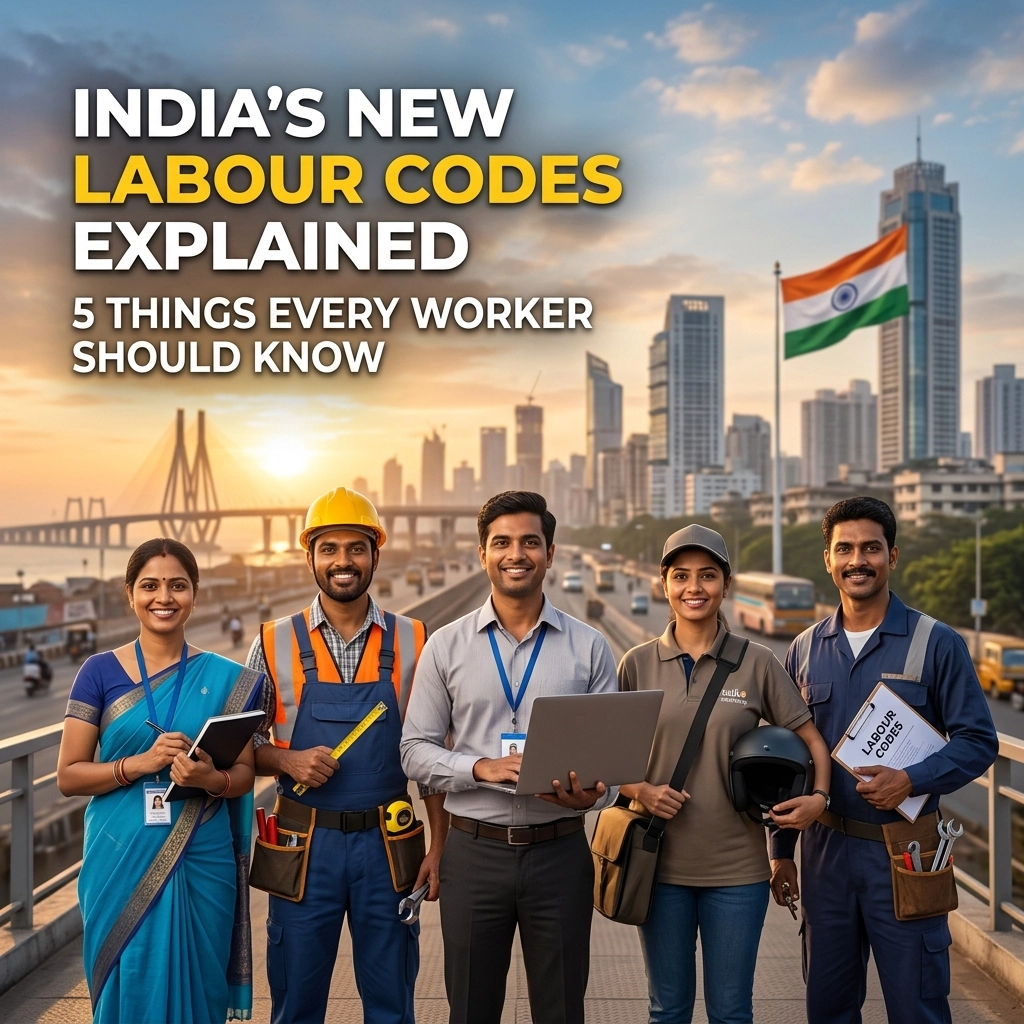
If you have been keeping an eye on the news lately, you know that the Indian employment landscape just went through its biggest makeover since 1947. With the full implementation of the four new labour codes in 2026, the rules of the game have changed for everyone: from corporate CEOs to delivery partners. Understanding India’s New Labour Codes Explained is no longer just for HR departments; it is essential knowledge for every single person earning a paycheck in India today.
The government has consolidated 29 complex, archaic central labour laws into four streamlined codes: the Code on Wages, the Social Security Code, the Industrial Relations Code, and the Occupational Safety, Health and Working Conditions Code. These changes aim to balance the ease of doing business with enhanced worker protection. But what does it actually mean for your daily life? From the 48-hour weekly work cap to your right to a formal appointment letter, let’s dive into the five things you absolutely need to know.
1. Mandatory Appointment Letters: Ending the Era of Informal Work
One of the most significant shifts in India’s New Labour Codes Explained is the mandatory requirement for appointment letters. For decades, millions of workers in the unorganized sector operated on "verbal agreements," which left them vulnerable to sudden termination and denied them proof of employment for loans or benefits.
Now, every employer is legally bound to issue a formal appointment letter to every employee. This simple document formalizes the relationship, detailing your role, salary structure, and rights. It is the first step toward universal formalization of the Indian workforce.
- Transparency: No more hidden clauses or "he-said, she-said" disputes.
- Legal Standing: You now have a paper trail to claim your rightful benefits under the Coolblogs News section.
- Proof of Work: Essential for building a financial profile or seeking new opportunities.
 )
)
Alt Text: India’s New Labour Codes Explained – A worker receiving a formal appointment letter in a modern office.
2. Universal Social Security: Security for the Gig Economy
For the first time in Indian history, the law recognizes that "work" isn't just a 9-to-5 office job. India’s New Labour Codes Explained brings gig workers and platform workers: think your favorite food delivery riders, cab drivers, and freelance designers: under the umbrella of social security.
The Social Security Code, 2020, mandates the creation of a Social Security Fund specifically for these workers. This fund will provide benefits like maternity leave, disability insurance, and old-age protection.
Quick Stats for Gig Workers:
- Coverage: Millions of previously "invisible" workers are now entitled to state-backed insurance.
- Contribution: A small percentage of the turnover from aggregators (like Zomato, Swiggy, or Uber) will go directly into this welfare fund.
- Digitization: Workers can register on a national portal to access these benefits directly.
This move ensures that as India moves toward an Acche Din digital economy, no worker is left behind without a safety net.
3. Free Health Check-ups and Occupational Safety
The new codes place a massive emphasis on the physical well-being of the workforce. Under the Occupational Safety, Health and Working Conditions (OSH) Code, employers are now mandated to provide free annual health check-ups for workers who have reached the age of 40.
This is a game-changer for long-term Health is Wealth strategies within the corporate world. Beyond just health check-ups, the codes specify:
- Sanitation: Mandatory clean drinking water and separate latrines for men and women.
- Work Environment: Stricter rules on ventilation, lighting, and safety protocols in hazardous industries.
- Consent for Overtime: While the 48-hour weekly cap remains (usually 8 hours a day for 6 days), any overtime requires the worker's consent and must be paid at double the ordinary wage rate.
4. Gender Equality: Night Shifts and Safety for Women
In a move to boost the Female Labour Force Participation Rate (FLFPR), India’s New Labour Codes Explained has cleared the path for women to work in all types of establishments, including night shifts.
Previously, many sectors were restricted for women during late hours. Now, women can work between 7 PM and 6 AM, provided:
- Consent: The woman explicitly agrees to the shift.
- Safety: The employer provides adequate security, transportation, and facilities.
- Dignity: Workplaces must maintain a zero-tolerance policy toward harassment.
This ensures that gender is no longer a barrier to career growth or high-paying roles in manufacturing and tech sectors that operate 24/7.
 )
)
Alt Text: India’s New Labour Codes Explained – A woman engineer working a night shift in a secure facility.
5. The National Reskilling Fund: A Safety Net for Job Loss
The world is changing fast. Automation and AI are shifting job requirements overnight. Recognizing this, the government has introduced the National Reskilling Fund.
If a worker is retrenched (laid off due to business closure or downsizing), the employer must contribute an amount equal to 15 days of the last drawn wages into this fund. This money is specifically earmarked for the worker to learn new skills and find a new job.
How it works:
- The amount must be credited to the worker's account within 45 days of retrenchment.
- It serves as a financial bridge while the worker transitions between roles.
- It encourages a culture of lifelong learning, which we often discuss in our Content Marketing blogs.
Latest Trends in Indian Labour (2026)
- The 48-Hour Cap: Most companies are sticking to the 8-hour, 6-day week, but some are experimenting with 12-hour, 4-day weeks to allow for longer weekends…
- Digital Portals: The Shram Suvidha portal has seen a 300% increase in registrations this year…
- Overtime Pay: Stricter enforcement has led to a significant boost in take-home pay for factory workers…
- Leave Encashment: New rules make it easier to carry forward and encash unused leaves at the end of the year…
Popular Discussions
- Minimum Wage: The new National Floor Wage ensures that no state can set a minimum wage below the federal limit…
- Contractual Rights: Fixed-term employees now get the same statutory benefits as permanent ones…
- Grievance Redressal: Every establishment with 20+ workers must have a committee to solve disputes internally…
📌 Trending Now
- Work-Life Balance: How the 48-hour cap is affecting productivity in Mumbai's tech hubs…
- Gig Worker Rights: A deep dive into the first insurance payouts for delivery partners…
- Safety First: New OSH standards for the construction industry in Delhi…
📈 Recent Updates
- May 10, 2026: Government releases new guidelines for the Reskilling Fund…
- May 08, 2026: Survey shows 85% of women feel safer with the new night-shift protocols…
- May 05, 2026: National Floor Wage updated for the second quarter…
Conclusion: A New Era for the Indian Worker
The implementation of India’s New Labour Codes Explained marks a pivot toward a more structured, fair, and modern economy. While there are still debates about the increase in employer flexibility, the core benefits for workers: like universal social security, mandatory appointment letters, and the reskilling fund: provide a much-needed safety net in a volatile world.
Whether you are a freelancer or a full-time professional, knowing your rights is the first step toward workplace empowerment. Keep an eye on our Home page for more updates on how these laws evolve throughout 2026.
View Count: 45,203 views
Published: May 11, 2026
[Load More Articles] | [Subscribe to Coolblogs]
That’s all for now! We hope this breakdown helps you navigate your career with a bit more confidence. Stay safe and keep growing! 🥰
For more information about who we are, visit our About Us page or check out our latest Entertainment and Travel tips!