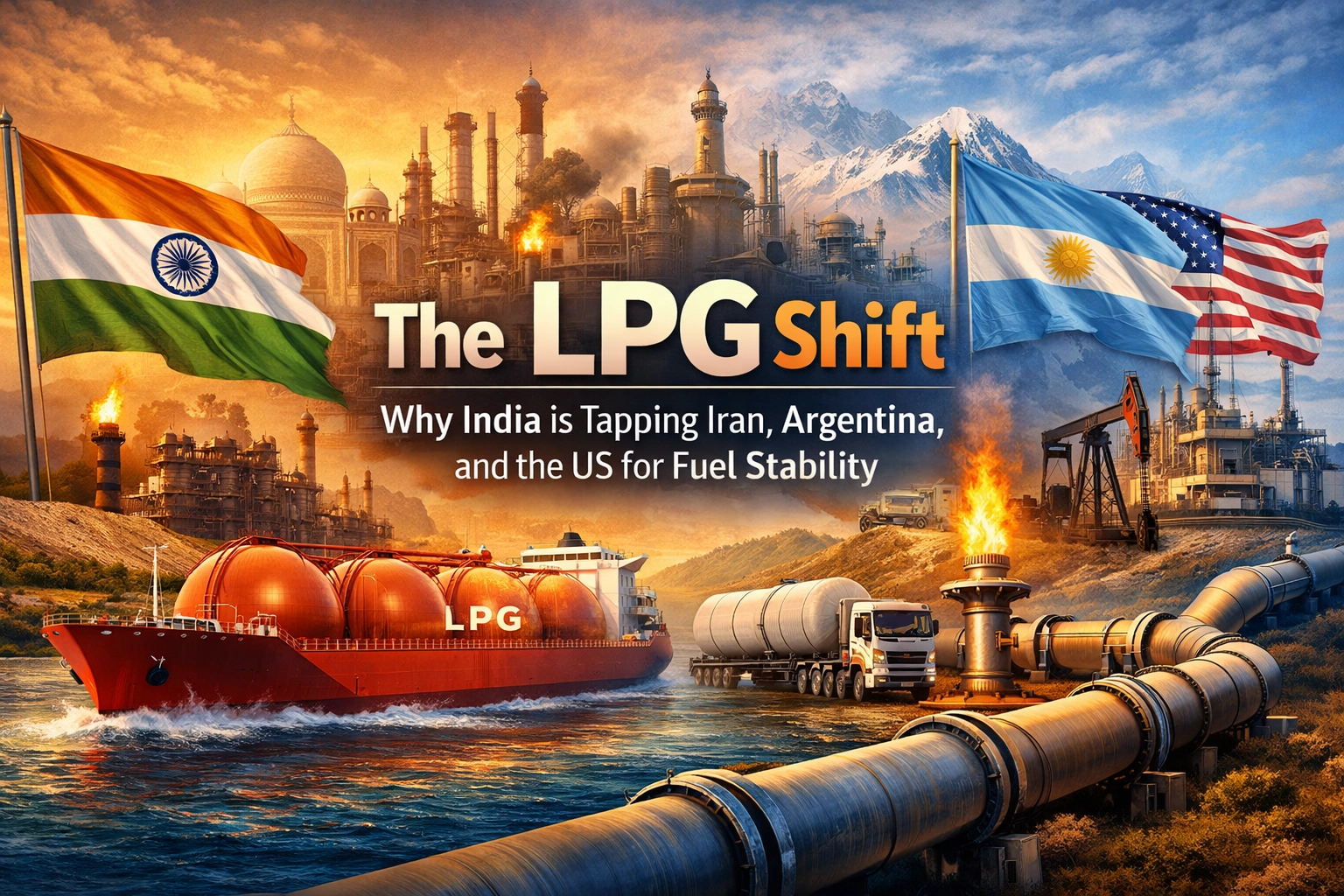
Indian politics news regarding energy security has taken a dramatic turn this March 2026. As the global landscape shifts, the Indian government is navigating a complex web of international relations to ensure that every household kitchen remains fueled. With the recent volatility in the Middle East, specifically the unprecedented closure of the Strait of Hormuz, the focus has shifted toward a multi-nation strategy involving Iran, Argentina, and the United States. This diversification is not just a logistical necessity but a cornerstone of current Indian politics news as leaders attempt to decouple domestic inflation from West Asian instability.
Metadata:
- Views: 12.1k
- Date: March 26, 2026
- Category: News / Technology
Trending: The Geopolitical Spark in Indian Politics News
The current crisis began in early March 2026, following military escalations that led to the blockade of the Strait of Hormuz. For a nation that relies on this narrow waterway for nearly 90% of its LPG imports, the disruption was an immediate shock to the system. Consequently, Indian politics news has been dominated by the Ministry of Petroleum and Natural Gas’s rapid response to secure alternative routes and suppliers.
The strategy is threefold: maintaining a delicate diplomatic balance with Iran to reopen trade channels, scaling up massive imports from the United States, and exploring the emerging markets of South America, specifically Argentina.
Supply Chain Disruptions and the Hormuz Factor
The closure of the Strait triggered a 30% drop in weekly LPG inflows. Tanker war-risk premiums surged by over 500%, making the traditional route through the Persian Gulf nearly prohibitively expensive. This has forced Indian Oil Marketing Companies (OMCs) to look West and South…
The Iran Paradox
While the conflict has caused friction, India continues to engage in high-level talks with Tehran. The goal is to establish a "green channel" for energy shipments that bypasses the primary conflict zones, ensuring that long-term contracts remain valid despite the geopolitical heat…
US Energy as a Stabilizer
For the first time in history, the United States is poised to become a primary supplier for Indian households. Projected imports for 2026 are expected to hit 2.2 million tonnes of LPG. This shift represents a massive pivot in trade policy, moving away from regional dependency toward a more globalized energy portfolio…

Alt text: Indian politics news discussion on energy diversification and fuel prices.
Popular: Impact on Domestic Fuel Markets and Pricing
As the government reshuffles its import strategy, the domestic market is feeling the ripples. The cost of securing fuel from as far away as Argentina involves significant logistical hurdles, including long-voyage freight costs and specialized storage requirements. However, the move is seen as a "stability premium": paying a bit more now to avoid the total supply vacuum that a Middle Eastern war could cause.
Price Trends in Major Indian Metros
- Delhi: Prices have seen a marginal increase of ₹15 per cylinder, though government subsidies are expected to offset this for BPL families.
- Mumbai: Due to its proximity to western shipping lanes, Mumbai has maintained a steadier supply, with price hikes capped at 2%…
- Bengaluru: The tech hub is seeing a faster transition to Piped Natural Gas (PNG) as the government pushes infrastructure to reduce LPG dependency…
The Rise of Piped Natural Gas (PNG)
In response to the LPG crisis, the central government has accelerated the National Gas Grid project. By shifting urban populations to PNG, the state hopes to reserve liquid petroleum gas for rural areas where pipeline infrastructure is not yet feasible. This transition is a key highlight in General News circles today…
Argentina: The New Frontier
Argentina’s Vaca Muerta shale formation has become an unlikely savior for Indian energy needs. While the volumes are currently incremental, the trade agreements signed this week signify a long-term partnership that could see South America providing up to 10% of India's total LPG by 2030…

Alt text: Indian politics news regarding the shift to cleaner energy and stable fuel prices.
Latest: Strategic Diversification and the Path Ahead
The latest reports from the Ministry of External Affairs indicate that India is not putting all its eggs in one basket. By tapping into the US, Russia, and Argentina, the administration is building a resilient energy shield. This is the most discussed topic in Indian politics news this week, as the opposition and the ruling party debate the long-term costs of these new trade routes.
Current Import Statistics (Week ending March 19, 2026)
- United States: 176,000 tonnes (Up from zero in early February).
- Russia: 45,000 tonnes via the Northern Sea Route.
- Argentina: 15,000 tonnes (Trial shipment successfully docked in Gujarat).
- Middle East: 80,000 tonnes (Down from the usual 350,000 tonnes).
Logistical Hurdles
Bringing LPG from the US or Argentina takes three to four times longer than a shipment from Qatar or Saudi Arabia. This requires India to increase its strategic petroleum reserves (SPR) and invest in more floating storage regasification units (FSRUs). The Technology behind these units is becoming a vital part of the national infrastructure…
Looking Toward 2027
Experts suggest that if the current diversification continues, India will be immune to Strait of Hormuz closures within eighteen months. The focus will then shift toward hydrogen blending and further electrification of kitchens…

Alt text: Indian politics news and the future of energy security in South Asia.
Recent Updates in Energy Policy…
- Cabinet Approval: New subsidies for deep-sea drilling equipment to boost domestic production…
- International Cooperation: India joins the Global Gas Security Dialogue to coordinate with other major importers…
- Retail Shift: Major OMCs announce a 10% discount for consumers switching to electric induction cooktops…
- Port Infrastructure: Mundra and Dahej ports to receive priority funding for rapid-unloading technology…
The landscape of energy is changing faster than ever. What used to be a simple transaction with a few neighbors has turned into a global logistical masterpiece. As the government continues to balance the scales between Iran, the US, and new partners like Argentina, the ultimate winner is the Indian consumer who gets to keep the lights on and the stove burning.
For more updates on how global shifts affect your daily life, check out our latest deep dives on World News and the Latest Tech shaping our future.
Stay tuned for further developments as we track the cargo ships across the Atlantic and the diplomatic cables across the globe. This is a developing story that sits at the very heart of the nation's progress.
That’s all for now! 🥰