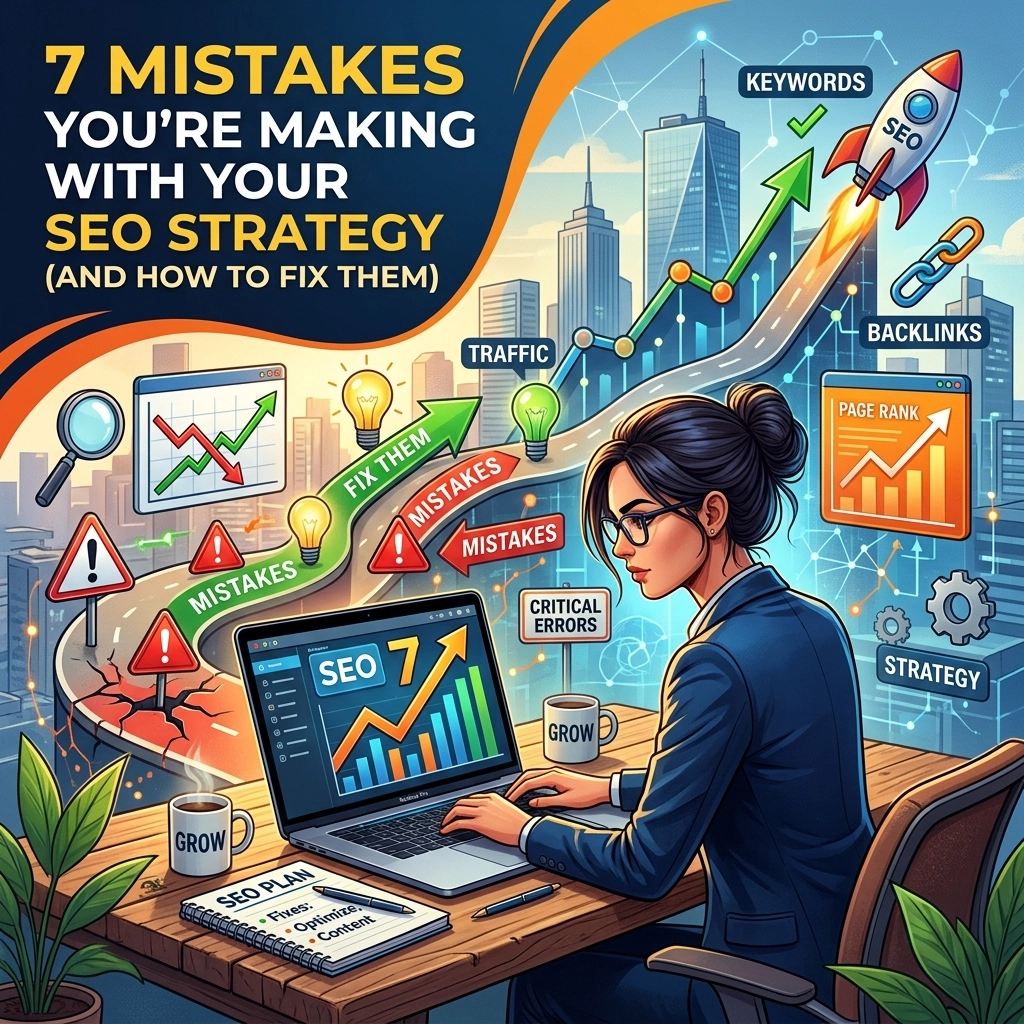
Focus Keyword: SEO Strategy
If you feel like your SEO Strategy is stuck in 2022, you aren’t alone. The digital landscape has shifted dramatically, especially with the rise of generative AI and semantic search. What worked a few years ago: keyword stuffing and thin content: is now the fastest way to get buried on page ten of the search results.
At Coolblogs, we see businesses making the same errors repeatedly. In April 2026, search engines are smarter than ever. They don't just look for words; they look for meaning, authority, and user satisfaction. If you want to stay ahead, you need to pivot.
Here are the 7 biggest mistakes currently killing your rankings and, more importantly, how you can fix them right now.
1. Ignoring Semantic Search and Contextual Meaning
The biggest mistake in any modern SEO Strategy is treating Google like a simple dictionary. In 2026, search engines use Large Language Models (LLMs) to understand the intent behind a query. If you’re still focusing on exact-match keywords while ignoring the broader topic, you’re missing out.
The Mistake: Creating content that only targets a specific string of words without providing comprehensive coverage of the topic.
The Fix: Transition from "keyword research" to "entity and topic research." Use tools to identify related concepts and questions users are asking. Ensure your content answers the "why" and "how," not just the "what."

Alt-text: Improving your SEO Strategy through semantic search mapping.
Trending in Technology
- AI-Driven Search: How SGE is changing the click-through rate…
- Voice Search 2.0: Why conversational queries are dominating…
- Neural Matching: Understanding how Google connects ideas…
Load More
2. Optimizing for Bots Instead of User Intent
Search engines have one goal: to keep users happy. If your SEO Strategy prioritizes "gaming the algorithm" over providing actual value, your bounce rate will skyrocket, and your rankings will plummet.
The Mistake: Writing clickbait titles that don't deliver or burying the answer to a user’s question under 500 words of fluff.
The Fix: Identify the user intent (Informational, Transactional, Navigational). If someone searches for "how to fix a leak," give them the steps immediately. Don't make them read the history of plumbing first. High engagement metrics are the strongest ranking signals today.
3. Neglecting Technical SEO Foundations
You can have the best content in the world, but if your site is a technical mess, no one will see it. We often see great sites ruined by simple technical oversights.
The Mistake: Ignoring Core Web Vitals, having broken 404 pages, or failing to implement proper 301 redirects during a site migration.
The Fix: Perform a monthly technical audit. Use Google Search Console to monitor crawl errors. Ensure your site loads in under 2 seconds, especially on mobile devices. If you need help understanding the basics of site health, check out our About Us page to see how we handle digital media.

Alt-text: Technical SEO Strategy audit showing site health metrics.
Popular Digital Tips
- Speed Optimization: 5 plugins to boost your WordPress site…
- Redirect Maps: Why your old URLs are killing your traffic…
- Sitemap Secrets: How to get indexed in minutes, not days…
See All Topics
4. Overlooking Internal Linking Structures
Internal links are the "roads" that allow search engine crawlers to navigate your site. Without a clear path, your most important pages might remain "orphaned" and unranked.
The Mistake: Linking to random pages or using generic anchor text like "click here."
The Fix: Use descriptive, keyword-rich anchor text that tells the reader (and the bot) exactly what the next page is about. Create "topic clusters" where a main pillar page links to several specific sub-topic articles. This builds topical authority and keeps users on your site longer.
5. Failing to Adapt to AI-Generated Search Overviews
With the integration of AI into search engines, many users get their answers directly on the search results page (Zero-click searches). Your SEO Strategy must account for being the source of that AI answer.
The Mistake: Not using structured data (Schema markup) to help AI understand your content.
The Fix: Implement Schema.org markup for FAQs, Reviews, and Articles. This increases your chances of appearing in the "featured snippets" or being cited by AI search assistants. It’s about becoming a "preferred source" for the LLMs.

Alt-text: Visualizing a modern SEO Strategy for AI-integrated search results.
6. Creating Content Quantity Over Content Quality
The "post every day" mantra is dead. In the age of AI-generated spam, search engines are penalizing sites that pump out low-effort, repetitive content.
The Mistake: Using AI to generate thousands of mediocre blog posts without human oversight or unique insights.
The Fix: Focus on E-E-A-T (Experience, Expertise, Authoritativeness, and Trustworthiness). Share personal anecdotes, original data, or unique case studies. One "power post" that becomes a resource for others is worth more than 50 filler posts. If you are looking for high-quality examples, browse our News section.
Recent News
- Algorithm Update: What the March 2026 leak tells us about rankings…
- Content Decay: How to refresh your old posts for a 20% traffic boost…
- The Death of Backlinks? Why social signals are the new currency…
Load More News
7. Ignoring the Mobile-First User Experience
While we’ve talked about mobile for years, many SEO Strategy plans still treat mobile as a secondary thought. In 2026, "mobile-friendly" is the bare minimum; you need to be "mobile-optimized."
The Mistake: Having intrusive pop-ups that cover the screen on mobile or buttons that are too small to click.
The Fix: Design for the thumb. Ensure all navigation is easy to use on a small screen. Test your site on various devices to ensure the layout doesn't break. A poor mobile experience leads to a quick exit, which signals to search engines that your site isn't helpful.

Alt-text: High-performing SEO Strategy focusing on mobile user experience.
Summary of Fixes for Your 2026 SEO Strategy
| Mistake | Quick Fix |
|---|---|
| Keyword Stuffing | Focus on Semantic Search and related entities. |
| Thin Content | Prioritize E-E-A-T and original research. |
| Slow Speeds | Optimize images and use a CDN. |
| No Schema | Use JSON-LD to talk to AI search engines. |
| Poor UX | Implement a mobile-first design philosophy. |
Why This Matters Now
The cost of acquiring customers through ads is at an all-time high. A robust, organic SEO Strategy is the only way to ensure long-term, sustainable growth. By fixing these seven common errors, you aren't just pleasing an algorithm; you are building a better experience for your customers.
If you're interested in how different industries are handling these shifts, you might find our coverage on Fashion or Entertainment helpful, as these sectors often lead the way in visual and intent-based search trends.
Latest from Coolblogs
- World Trends: How global events impact search behavior…
- Politics & Data: The role of SEO in the 2026 election cycle…
- Sports Marketing: Why "Real-Time" SEO is the future of fan engagement…
Explore All
That’s all for now! SEO is a marathon, not a sprint, but making these small tweaks today will set you miles ahead of the competition. If you have any questions about your specific site, don't hesitate to reach out through our Contact Us page.
Happy ranking! 🥰✨